
Grid Impact Study (GIS) Impact Study for PLTS Installation at the Ceres Factory

Ceres Factory (PT Perusahaan Industri Ceres) plans to increase its energy sustainability by installing a Solar Power Plant (PLTS) with a capacity of 2,163 MWp on the factory roof. To ensure that the integration of PLTS does not disrupt the existing electricity network, a Grid Impact Study (GIS) was carried out. GIS is an important study that evaluates the impact of adding new components or configuration changes to existing electrical networks. This article will discuss the importance of GIS, the stages involved, and the results of various related studies.
The Importance of Grid Impact Study (GIS)
GIS, or Grid Impact Study, is a study that aims to evaluate the impact of adding new components or configuration changes to the electricity network on the existing network. The main goal of GIS is to ensure that these changes do not cause instability or disruption to the existing power grid. GIS is very important to predict and prevent potential problems that can affect the operation of the electricity network as a whole.
Location and Specifications of PLTS at the Ceres Factory
This project is located at the Ceres Factory, with a PLTS installation with a capacity of 2,163 MWp on the factory roof. This installation will be interconnected via LVMDP panels at a voltage of 400 V. This PLTS will be connected at two interconnection points at two different LVMDP and MVMDP to distribute the load more efficiently and ensure network stability.
Studies Conducted in GIS
Various studies conducted in GIS using ETAP software include:
- Load Flow Study: Analyzing the power flow in the electrical network to evaluate busbar voltage, cable loading, and transformer loading in steady-state conditions.
- Short Circuit Study: Analyzing short circuit fault current levels to ensure the current does not exceed the breaking capacity of existing equipment.
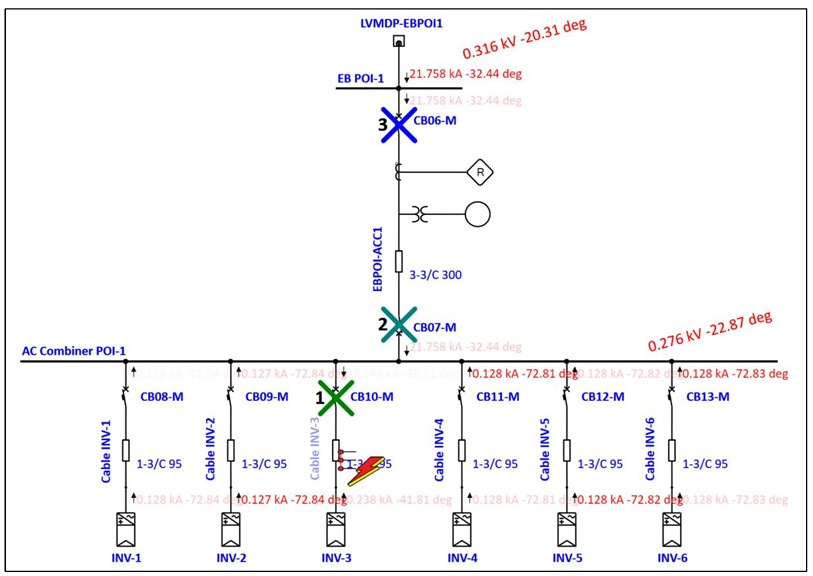
- Protection & Coordination Study: Manages the coordination of protection equipment and equipment settings that need to be changed due to new components or configuration changes.
- Arc Flash Study: Analyzes incident energy values and determines the Personal Protective Equipment (PPE) needed to protect workers from sparks due to electrical disturbances.
GIS Implementation Stages
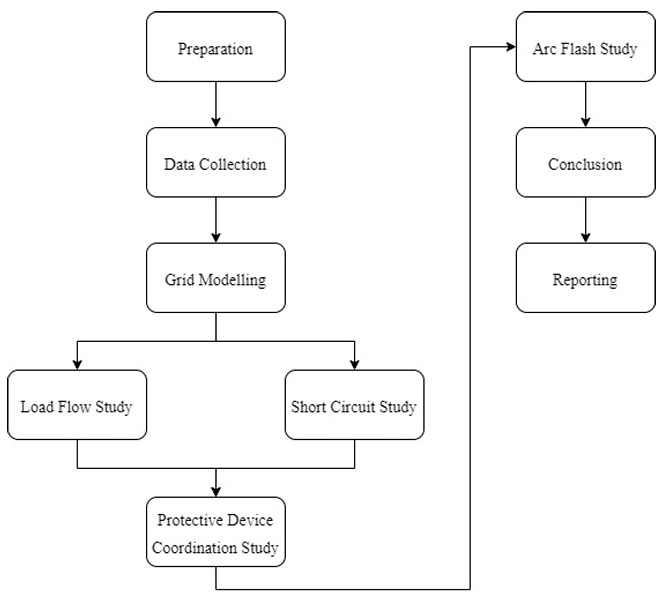
Stages of GIS implementation at the Ceres Factory include:
- Data Collection: Collection of data on existing equipment and new generating equipment from the PT Perusahaan Industri Ceres engineering team. Data collected includes transformers, cables, busbars, SLDs, load profiles, inverters, and breaking capacity.
- Grid Modeling: Creating electrical network models for simulation.
- Load Flow and Short Circuit Study: Simulation of power flow and short circuit fault current.
- Protection & Coordination Study: Analysis and regulation of protection relays.
- Arc Flash Study: Evaluation of incident energy and determination of PPE category.
- Recap of Simulation Results and Analysis: Recap of simulated data results and summarized parameter analysis.
- Reporting: Creation of a final report that includes all findings and recommendations.
Results from Each Study
- Load Flow Study: The increase in existing busbar voltage after PLTS is not significant. The load on existing cables and transformers has decreased because the load is directly supplied by PLTS.
- Short Circuit Study: PLTS does not contribute significantly to short circuit currents, so there is no need to uprate the breaking capacity of existing equipment.
- Protection & Coordination Study: Setting protection relays and LSI protection on PV system circuit breakers ensures fast, sensitive, selective and reliable fault isolation.
- Arc Flash Study: Obtain incident energy values, arc flash boundary, and required PPE categories. This information sticker is placed on the equipment for safety guidance.
 Conclusion
The Grid Impact Study (GIS) for the PLTS installation at the Ceres Factory shows that PLTS integration can be carried out safely without disturbing the existing electricity network. The studies carried out show increased efficiency and reduced load on existing systems, without posing a significant risk to fault currents. Proper protection settings ensure operational safety, and arc flash evaluation provides guidance for worker safety. Thus, the implementation of PLTS not only increases energy efficiency but also maintains the stability and security of the factory’s electricity network.
The Ceres factory can confidently proceed with their solar PV project, knowing that all technical and safety aspects have been analyzed and optimized through GIS. This is a big step towards sustainability and better energy efficiency